HV station arresters
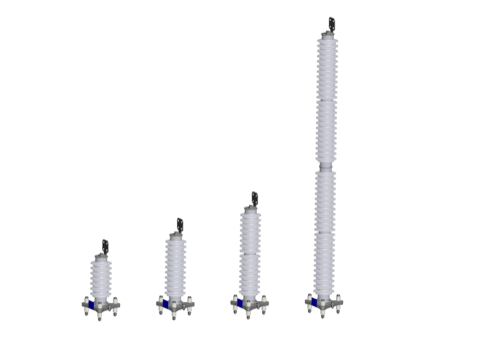
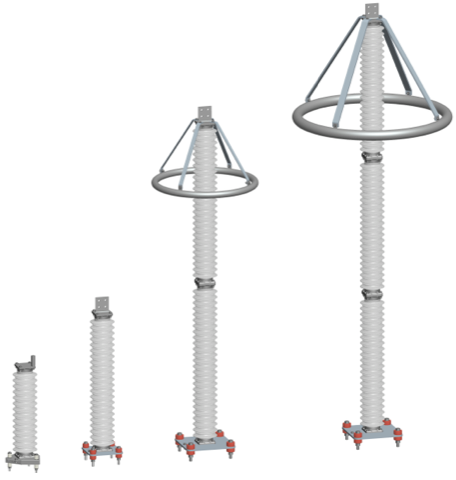
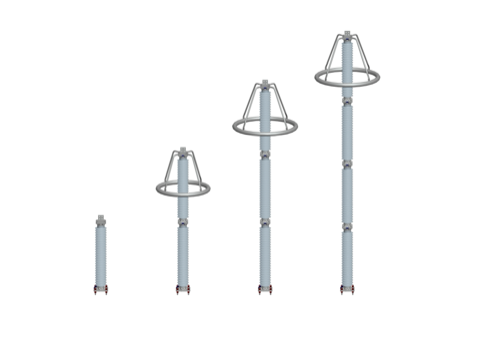
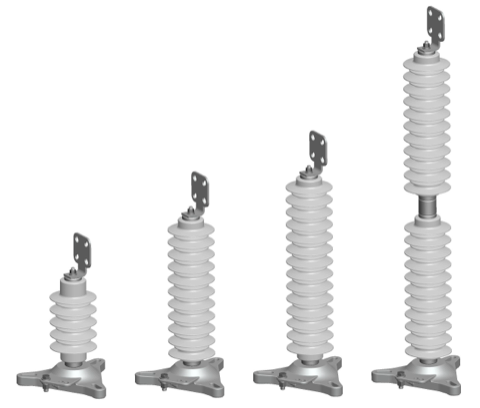
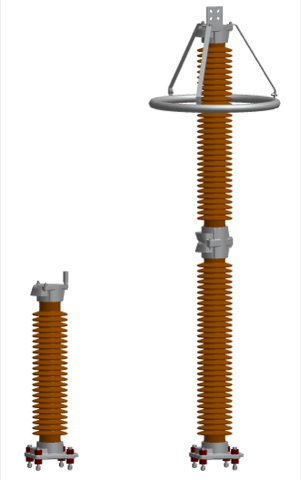
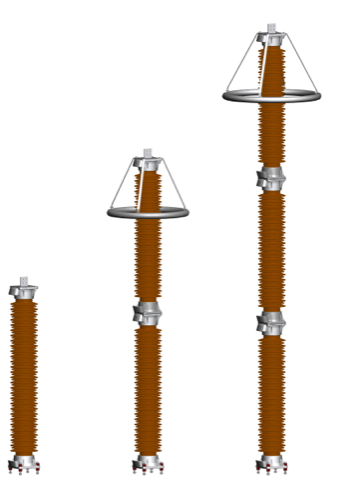
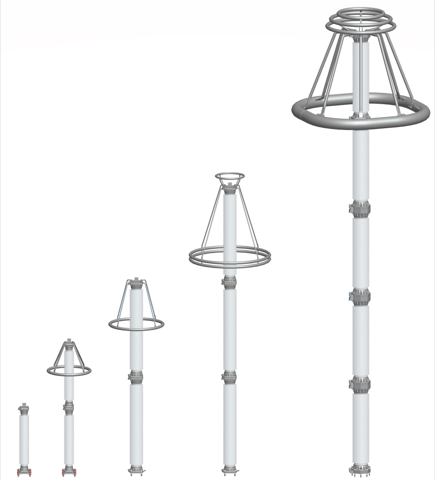
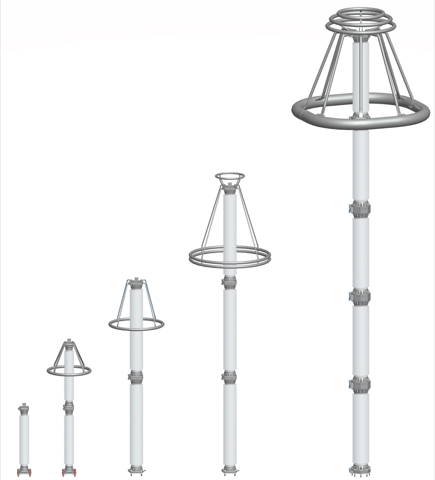
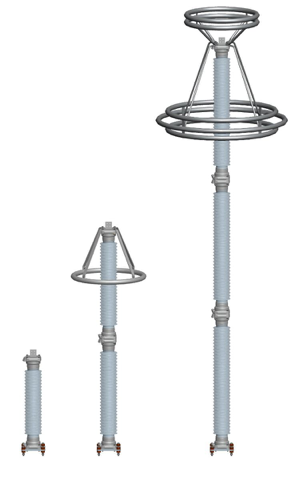
Metal-oxide station arresters protect transformers, circuit breakers and switchgear against lightning and switching overvoltages by diverting surge currents safely to ground. This category covers three housing technologies across eleven families: the 3EL silicone Cage Design series (3EL1, 3EL2, 3EL3, 3EL5), the 3EP porcelain series (3EP3, 3EP4, 3EP5, 3EP6) and the 3EQ composite hollow-core series (3EQ1, 3EQ3, 3EQ4), spanning system voltages up to 800 kV with nominal discharge currents of 10 kA and 20 kA.
A station arrester is a heavy-duty metal-oxide surge arrester installed in a substation to protect transformers, circuit breakers and switchgear from lightning and switching overvoltages. Its active part is a column of metal-oxide varistor blocks that is almost non-conductive at normal operating voltage but becomes highly conductive during a surge, diverting the surge current to earth and limiting the voltage across the protected equipment to the arrester's protective level. Station-class designs per IEC 60099-4 cover systems up to 800 kV with nominal discharge currents of 10 or 20 kA, and are built with silicone cage-design, porcelain or composite hollow-core housings depending on mechanical and site conditions. Glossary →
System-voltage coverage per family (√ scale) — bars link to the product pages. Families without a published kV rating are not drawn.
23 of 23 products
Why it matters
Every transformer, breaker and busbar in a substation is insulated for a defined withstand level, and a single lightning stroke or switching transient can exceed it in an instant. Station arresters are the last line of defense: their metal-oxide varistors behave as insulators at operating voltage and turn highly conductive within nanoseconds of an overvoltage, clamping the voltage across the protected equipment to a safe residual level. Because the arrester sits permanently on the busbar, its long-term reliability matters as much as its protective level — the observed failure rate of these high-voltage arresters is well below 0.1% per year (a mean time between failures of over 1,000 years), with reported failures traced almost entirely to external causes such as direct strokes beyond specification or transport damage rather than the arrester itself. Service experience and tear-down inspections of units returned from the field support a life expectancy of at least 40 years, over which the units are maintenance-free with no serviceable internal parts. The housing choice — soft silicone cage, porcelain, or composite hollow core — determines mechanical strength, seismic and pollution performance, and overload behavior, which is why the same protection duty is offered in three distinct constructions.
Failure rate below 0.1% per year
Field experience puts the failure rate of these high-voltage arresters far below 0.1% per year — an MTBF of more than 1,000 years — with reported failures almost entirely attributable to external causes such as out-of-spec direct strokes or transport damage.
Maintenance-free for 40+ years
There are no serviceable parts inside; sealed silicone or porcelain housings prevent moisture ingress for the life of the unit. Service experience and inspections of returned units support a life expectancy of at least 40 years, with only periodic visual checks recommended.
Three housings for every site condition
The 3EL silicone Cage Design is lightweight and lets overload arcs escape the soft housing without ejecting parts; 3EP porcelain and 3EQ composite hollow-core designs add directional pressure relief and the mechanical strength needed for seismic zones, high wind loads and support-insulator duty.
A century of arrester engineering
This product line traces back to the first surge arrester developed at Schaltwerk Berlin in 1925. The current 3EL, 3EP and 3EQ families cover system voltages up to 800 kV with 10 kA and 20 kA nominal discharge currents and line discharge classes up to 5.
Frequently asked questions
How does a metal-oxide station arrester actually work?
The active element is a stack of metal-oxide varistors (MOVs) — nonlinear resistors that are effectively insulators at normal operating voltage. When a lightning or switching overvoltage arrives, the MOVs become conductive within nanoseconds and divert the surge current to ground, holding the voltage across the protected transformer or switchgear below its insulation withstand level. Once the transient passes, the varistors return to their insulating state without any moving parts or follow-current interruption.
When should I choose porcelain, silicone cage, or composite hollow-core housing?
The 3EL silicone Cage Design (3EL1/3EL2/3EL3/3EL5) is the lightweight default for most station and line duties: hydrophobic, UV-resistant silicone molded directly onto the MOV stack, with overload arcs escaping the soft housing safely. The 3EP porcelain families (3EP3–3EP6) suit heavy-duty installations in seismic or high-wind areas, where the rigid housing and directional pressure relief provide maximum robustness. The 3EQ composite hollow-core families (3EQ1/3EQ3/3EQ4) combine silicone housing with an FRP hollow core for very high mechanical strength, and can double as support insulators.
Do station arresters need maintenance, and how long do they last?
These arresters are maintenance-free — there are no serviceable parts inside the sealed housing. Periodic visual inspection for external damage or heavy pollution is sufficient, plus any rules specific to an installed monitoring device. Based on service experience and inspection of units returned from the field, life expectancy is at least 40 years, and the observed failure rate is far below 0.1% per year.
How do I select the right arrester family from this catalog?
Start from your highest system voltage Us and required nominal discharge current: each family page states its envelope in the key specs (for example 3EL5 covers Us ≤ 72.5 kV at 10 kA, 3EL2 up to 420 kV at 10/20 kA, 3EL3 and 3EQ4 up to 550 kV at 20 kA, and 3EP3, 3EP6 and 3EQ3 up to 800 kV). Then narrow by line discharge class, housing technology and mechanical requirements using the grouped spec tables on each product page, and check the applications section to confirm the family is qualified for your duty (transformer, switchgear, or line protection).
What information should I include when requesting a quote?
The fastest path is a complete type designation from the family's designations list (for example 3EL20302PC314NH5 or 3EQ31245CZ7E), since it encodes the full electrical and mechanical configuration. If you don't have one yet, provide your system voltage Us, rated voltage Ur, nominal discharge current, line discharge class, creepage requirement and site conditions (seismic, coastal or polluted atmosphere), and reference the family whose spec table matches. Datasheets and drawings in each product's downloads section help confirm the selection before you submit.
Can these station arresters also be used on transmission lines?
Yes — the 3EL silicone cage families are explicitly suited to both station and line-surge-arrester duty (the 3EL2, for instance, is specified for station and line applications across 12–420 kV systems), and 3EQ hollow-core designs can likewise serve beyond pure station duty, including as support insulators. Porcelain 3EP families are primarily station arresters for substation installation.
How should I handle aging arresters already installed in my substations?
Register your installed arresters with their type designations and serial numbers so the exact configuration is on file. Given a life expectancy of at least 40 years, replacement is usually driven by substation upgrades or changed system parameters rather than wear-out; when a unit does need replacing, the designation on its nameplate maps directly to a current catalog entry or its successor. Our service side can assist with condition assessment, replacement planning and matching legacy designations to today's 3EL, 3EP and 3EQ families.