Line arresters (EGLA)
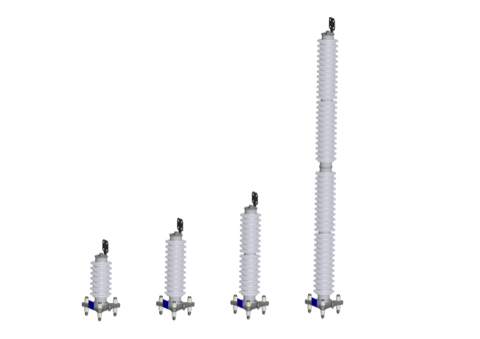
Externally gapped line arresters (EGLA) to IEC 60099-8 protect overhead transmission lines from lightning-caused flashovers: an external series spark gap galvanically isolates the series varistor unit (SVU) from line voltage in normal service, then flashes over during a lightning event to divert the surge. This catalog covers the 3EV family — 3EV5 (up to 72.5 kV, SVU based on 3EL5), 3EV1 (up to 252 kV, SVU based on 3EL1), and 3EV2 (up to 420 kV, SVU based on 3EL2) — all with silicone-rubber cage-design varistor units proven in station-arrester service.
Line arresters are surge arresters mounted on overhead power-line towers to stop lightning from flashing over the line's insulators — the main cause of lightning-related ground faults and momentary outages. An externally gapped line arrester (EGLA) keeps its metal-oxide varistor unit separated from the line by an external spark gap in normal service; when a lightning surge arrives, the gap sparks over, the varistor unit absorbs the surge, and the arc is extinguished within about 10 milliseconds so the line stays in service without a breaker trip. Because the gap isolates the varistor unit from line voltage, an EGLA carries no leakage current in normal operation and is designed and tested to IEC 60099-8. Glossary →
System-voltage coverage per family (√ scale) — bars link to the product pages. Families without a published kV rating are not drawn.
5 of 5 products
Why it matters
Lightning strikes on overhead lines cause insulator flashovers, ground faults, voltage dips, and momentary outages — a persistent reliability problem in regions with high ground flash density or poor tower footing resistance. Line arresters prevent the flashover itself by keeping lightning overvoltages below the insulator's lightning-impulse withstand level: the EGLA's external gap ignites during the strike, the SVU limits the follow current from several kiloamperes to a few amperes, and the arc extinguishes within about 10 milliseconds — before the circuit breaker needs to trip or reclose. Because the series gap keeps the varistor blocks disconnected from system voltage in normal operation, EGLAs carry zero leakage current, need no disconnector and no ground lead, and require a lower rated voltage than a gapless design — reducing varistor material and enabling compact installation on multi-circuit towers with short clearances. Placement matters as much as the device: simulation studies based on Cigré methods determine which phases and line segments to equip, so operators get sufficient protection from selectively placed arresters rather than blanket coverage. The result is a cost-effective line upgrade that avoids replacing insulators or adding shield wires.
Zero leakage current in normal service
The external series gap galvanically isolates the metal-oxide varistor blocks from line voltage until a lightning event ignites it. There is no continuous leakage current and no aging of the SVU from steady-state stress.
Arc extinguished within 10 ms — no breaker operation
On flashover the SVU limits the ground-fault current from several kiloamperes to a few amperes and quenches the arc within the first half-cycle, so the line stays in service without a circuit-breaker trip or reclosing operation.
Compact, gap-isolated design for tight tower geometries
No disconnector and no ground lead are required, simplifying installation and maintenance. The compact arrangement suits multi-circuit towers with short cross-arm clearances and supports live-line installation.
Station-proven SVU technology to IEC 60099-8
Each 3EV series varistor unit is based on the corresponding 3EL silicone-rubber cage-design station arrester (IEC 60099-4), with the complete EGLA designed and tested to IEC 60099-8 — covering system voltages from 3.6 kV up to 420 kV across the 3EV5, 3EV1, and 3EV2 families.
Frequently asked questions
What is an externally gapped line arrester (EGLA) and how does it work?
An EGLA is a line surge arrester whose metal-oxide series varistor unit (SVU) is connected to the line through an external spark gap rather than directly. In normal operation the gap keeps the SVU fully isolated from system voltage, so no current flows through it. When a lightning overvoltage exceeds the gap's ignition level — set below the insulator's flashover level — the gap sparks over, the SVU absorbs the surge and limits the follow current to a few amperes, and the arc extinguishes within roughly 10 milliseconds.
How does an EGLA differ from a non-gapped line arrester (NGLA)?
An NGLA is permanently connected to the line, so it responds to both lightning and switching overvoltages but carries a small continuous leakage current and needs a built-in disconnector for thermal-overload protection. An EGLA is isolated by its series gap in normal service — zero leakage current, no disconnector, no ground lead — and operates specifically on lightning overvoltages above the gap's ignition level. EGLAs follow IEC 60099-8, NGLAs follow IEC 60099-4; the gap also allows a lower arrester rated voltage, reducing varistor material.
Why install line arresters instead of upgrading insulators or adding shield wires?
Line arresters address lightning outages directly by clamping overvoltages below the insulator's lightning-impulse withstand level, preventing the flashover itself. They are particularly effective where ground flash density is high, tower footing resistance is poor, or double flashovers threaten multi-circuit towers. This makes them a cost-effective line upgrade because the existing insulators and tower geometry stay unchanged, and only selected phases or line segments need equipping based on a line study.
How do I choose between the 3EV5, 3EV1, and 3EV2 families?
Start with your maximum system voltage Us: 3EV5 covers up to 72.5 kV (In 10 kA, line discharge class 2), 3EV1 up to 252 kV (In 10 kA, class 2/3), and 3EV2 up to 420 kV (In 20 kA, class 2/3/4). Each family page lists the headline electrical ratings — maximum system voltage, rated voltage, nominal discharge current, short-circuit rating, and line discharge class — and the 3EV1 page adds a per-variant SVU ratings table with rated voltage Ur, continuous operating voltage Uc, residual voltage, housing height, and creepage distance. Which towers and phases to equip should come from a lightning-performance study of the specific line.
What information do I need to request a quote for an EGLA?
Provide the family designation (3EV5, 3EV1, or 3EV2) plus system voltage Us, arrester rated voltage Ur or continuous operating voltage Uc if already determined, and quantity per phase and tower. Line data that drives selection and gap dimensioning — insulator arcing distance and lightning-impulse withstand voltage, tower type, footing resistance, and local keraunic level — helps validate the choice; the spec tables on each product page cover the ratings needed to shortlist. Monitoring accessories such as the 3EX5 surge counter or ACM condition monitors can be added to the same request.
How is the number and placement of line arresters on a line determined?
Through a simulation study based on Cigré methods that models the specific line: operating voltage, span lengths and sag, conductor and ground-wire data, tower surge impedance and footing resistance, insulator arcing distance and withstand voltage, and the local keraunic level. The study identifies which phases and towers to equip so the line meets its outage-rate target without arresters on every structure, which is what makes selective EGLA deployment economical.
What maintenance do EGLA line arresters need over their service life?
The arresters themselves are maintenance-free with no serviceable parts; periodic visual inspection for external damage or heavy pollution is sufficient. Because the series gap eliminates continuous electrical stress on the SVU, there is no leakage-current aging to monitor in normal service. For lifecycle tracking, optional 3EX5 accessories — surge counters and ACM condition monitors — record discharge events per unit, and registering installed arresters with their designations simplifies later spares identification and replacement requests.