Long-rod & station post
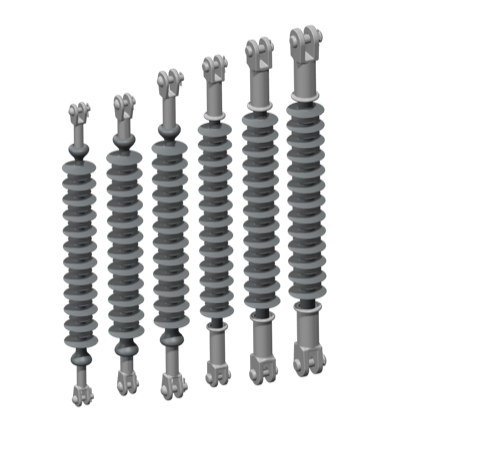
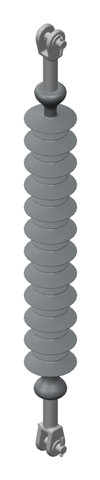
Composite insulators for overhead lines and substations: the 3FL long-rod family (3FL2 ≤ 70 kN, 3FL4 ≤ 120 kN, 3FL8) for suspension and tension application, the 3FT composite post range (SCL 18–150 kNm, single units to 5.5 m) for station and line post duty in AC and DC systems, and the 3FH hollow-core insulator for high-voltage apparatus housings. The long-rod and post families combine an HTV silicone rubber housing with an ECR glass fiber-reinforced core — boron-free on the 3FL long-rods — covering voltage classes Um 72.5 kV to 800 kV and mechanical classes SML 70 kN to 630 kN across the long-rod family.
Long-rod and station-post insulators are the components that hold energized overhead-line conductors and substation busbars while electrically isolating them from towers and structures. A long-rod hangs or anchors a conductor and is rated for tensile load (SML, in kN); a post insulator is a rigid column loaded in bending and rated by cantilever load (SCL, in kNm); hollow-core versions are tubes that form the outer housing of apparatus such as bushings. Composite designs use a fiber-reinforced (FRP) core for the mechanical load and a one-piece silicone rubber housing whose water-repellent surface keeps leakage current low in polluted environments, as a lighter, shatter-resistant alternative to porcelain or glass. Glossary →
System-voltage coverage per family (√ scale) — bars link to the product pages. Families without a published kV rating are not drawn.
22 of 22 products
Why it matters
Insulators do two jobs at once: they carry the full mechanical load of conductors or apparatus while holding off system voltage across every weather and pollution condition on the route. A long-rod in a suspension or tension string is a structural member of the line — its specified mechanical load (SML) is as much a selection criterion as its voltage class. In stations, post insulators support busbars and equipment, and hollow-core insulators form the external housing of bushings, instrument transformers and other apparatus. Composite designs replace porcelain and glass with a one-piece silicone housing on a fiber-reinforced rod or tube: lighter to handle and string, shatter-resistant, and — through the hydrophobicity transfer mechanism of HTV silicone — able to keep surface leakage currents low even under heavy pollution. Because a single failed insulator can take a line or a bay out of service, housing sealing, brittle-fracture-resistant core material and discharge-free molding are the details that determine long-term service reliability.
Pollution performance built into the housing
HTV silicone rubber with a hydrophobicity transfer mechanism keeps the surface water-repellent even under deposited pollution layers, for the highest pollution performance. Shed profiles come in multiple creepage factors (3.0/4.1 on 3FL4, 2.8/3.5/4.5 on 3FL8, 3.5/4.2 on 3FT posts) to match site pollution severity.
Brittle-fracture-resistant core
The load-bearing rod is boron-free ECR glass FRP, resistant to hydrolysis and acid attack — the acid-driven failure mode known as brittle fracture. Forged steel end fittings per IEC 61466-1 and ANSI C29.2 carry the mechanical load into the string hardware.
Discharge-free one-piece design
The housing is direct-injection-molded onto the rod in one piece, preventing internal partial discharges at the interface, and two sealing systems protect the triple point: system A with the triple point directly overmoulded (family classes up to 210 kN), system B sealed with elastic silicone gel (100–630 kN). An integrated grading ring keeps electrical field stress on the housing within limits.
One range from 72.5 kV to 800 kV
The 3FL long-rod family spans Um 72.5–800 kV and SML 70–630 kN, type-tested to IEC 61109, ANSI C29.11/C29.12 and CSA C411.4-16. The 3FT posts cover SCL 18–150 kNm with stackable units up to 5.5 m for AC and DC systems up to 800 kV, built to IEC 61952/ANSI C29.17 for line post and IEC 62231/ANSI C29.19 for station post duty.
Frequently asked questions
Why choose composite insulators over porcelain or glass?
A composite insulator replaces the ceramic body with a one-piece HTV silicone housing molded onto a fiber-reinforced core, making it lighter to transport and install and resistant to shattering from impact or vandalism. The silicone surface stays hydrophobic through a transfer mechanism, so leakage currents remain low in polluted or coastal environments where a wettable ceramic surface would rely on creepage length alone. The 3FL long-rods in this category are type-tested to IEC 61109, ANSI C29.11/C29.12 and CSA C411.4-16; the 3FT posts follow IEC 61952/ANSI C29.17 and IEC 62231/ANSI C29.19.
What is the hydrophobicity transfer mechanism?
HTV silicone rubber continuously migrates low-molecular-weight silicone to its surface, so even a pollution layer deposited on the shed becomes water-repellent. Water then beads instead of forming conductive films, which suppresses leakage current and dry-band arcing. This mechanism is why HTV silicone housings deliver the highest pollution performance without depending on extra creepage alone.
What prevents brittle fracture in these insulators?
Brittle fracture of composite insulators is driven by acid attack on the glass fibers of the core rod. The 3FL and 3FT families use a boron-free or ECR glass FRP rod that is hydrolysis- and acid-resistant, and the direct-injection-molded one-piece housing with sealed end-fitting interfaces keeps moisture away from the core. Two sealing systems cover the mechanical classes: system A overmoulds the triple point directly (up to 210 kN), system B seals the housing-to-fitting gap with elastic silicone gel (100–630 kN).
How do I choose between 3FL2, 3FL4 and 3FL8 long-rods?
Start from the mechanical class: 3FL2 covers SML up to 70 kN, 3FL4 up to 120 kN, and the 3FL family as a whole extends to 630 kN — the required SML follows from your conductor loads in suspension or tension application. Then match the shed profile to site pollution: 3FL4 offers creepage factors 3.0 and 4.1, 3FL8 offers 2.8, 3.5 and 4.5. Per-type SML, overall length and creepage distance are order-code specific — the 3FL4 page lists example designations such as 3FL4___-3__11-1XX9, and each product page carries the full spec table.
When do I need a post insulator (3FT) or hollow-core insulator (3FH) instead of a long-rod?
Long-rods (3FL) are tension members — they hang or anchor conductors and are loaded in tension only. Post insulators (3FT) are loaded in bending and support busbars, disconnectors or line posts, specified by cantilever class (SCL 18–150 kNm) with single units up to 5.5 m that can be stacked, for AC and DC systems up to 800 kV. Hollow-core insulators (3FH) are tubes rather than rods: they form the external housing of apparatus such as bushings and instrument transformers.
What information should I include in a quote request?
The fastest path is the type designation from the product page — for example a 3FL4 order code such as 3FL4___-3__11-1XX9 or a 3FT post type like 3FT4-4 — since it already encodes the key parameters. If you are still selecting, state the system voltage (Us) or required equipment voltage class (Um), the required mechanical rating (SML for long-rods, SCL for posts), application (suspension, tension, station post, line post, AC or DC), site pollution level or required creepage distance, and end-fitting type per IEC 61466-1 or ANSI C29.2. Long-rods can also be quoted in combination with line hardware and line surge arresters.
How do I handle replacements and spares for installed insulators?
Register your installed base with us so each insulator's type designation, string configuration and installation date are on file — a replacement or line-refurbishment quote can then be matched to the exact type without re-engineering the string. For upgrades, such as moving to a higher creepage profile in a polluted corridor, our services team can review the installed types and propose like-for-like or uprated alternatives from the same families.