Power transformers & reactors
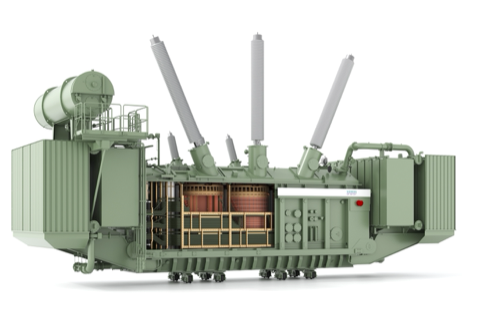
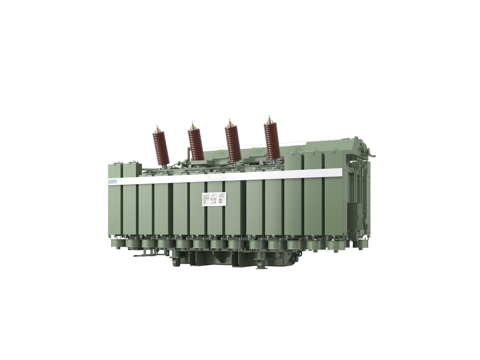
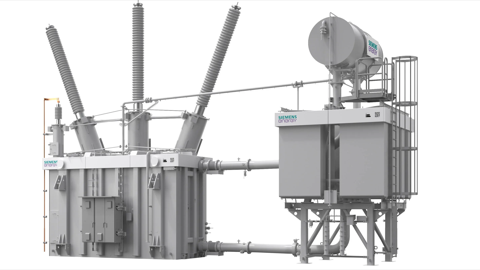
This category covers oil-immersed transformers and reactors for transmission and generation duty: medium power transformers (MPT) with 230 kV and 345 kV HV variants, large power and generator step-up transformers (LPT-GSU) up to 1,400 MVA and 765 kV, and shunt reactors (SR) in fixed and variable-reactance oil-immersed designs for EHV transmission, rated per network study. All families are built to IEC 60076-series or ANSI/IEEE C57 standards; the transformer families offer on-load tap changers and alternative insulating liquids as documented options, and digital condition monitoring is documented across the range.
Power transformers are the large oil-immersed transformers of transmission grids and power plants: they step generator output up to transmission voltage and interconnect networks at different voltage levels, at ratings from tens of MVA to over 1,300 MVA and insulation classes up to 800 kV, built to IEC 60076 or ANSI/IEEE C57. Each unit is custom-engineered to its network position, with on-load or de-energized tap changers to hold output voltage as grid conditions change. The class also includes shunt reactors — transformer-like devices per IEC 60076-6 that absorb the surplus reactive power of lightly loaded lines and cables to keep system voltage within limits. Glossary →
3 of 3 products
Why it matters
Power transformers convert voltage between grid segments — raising generation output to transmission levels so energy can travel long distances with low losses, then lowering it again toward distribution — which makes them the single point every megawatt-hour must pass through on its way from plant to load. Unlike distribution units, they operate at high and extra-high voltage (typically 10 kV to 800 kV, at ratings from tens of MVA to over 1,300 MVA) and are designed for continuous full-load and overload operation, so a failed unit can constrain an entire transmission corridor. Each unit is custom-engineered to its network position: winding configuration, tap-changer range, cooling stages, insulation level, and noise limits all follow from the site specification rather than from a stock design. Shunt reactors complement transformers by absorbing the reactive power that lightly loaded EHV lines generate, keeping voltage within limits without switching operations — the variable designs adjust compensation in steps via an on-load tap changer. As grids absorb more renewable in-feed and cross-border exchange, tap-changer regulation, loss performance, and condition monitoring on this equipment class increasingly determine how much stress a network can tolerate.
Loss-optimized designs above 99% efficiency
Efficiencies above 99% are standard across the power transformer family, with loss figures guaranteed per specification.
Tested to IEC 60076 and ANSI/IEEE before dispatch
Every unit passes factory acceptance testing including lightning impulse withstand, temperature rise, insulation resistance, and noise-level measurement; short-circuit tests are performed at internationally recognized institutes. Designs are available to ANSI C57.12.00 and IEC 60076 depending on market.
Insulating liquid matched to the site
Beyond mineral oil, the transformer families can be specified with biodegradable natural or synthetic esters or silicone oil for locations with high fire-safety and environmental requirements — esters offer higher fire points and ready biodegradability.
Condition monitoring built in, not bolted on
Documented options include Sensformer Advanced/Edge digital monitoring with a thermal digital twin (24 h load-scenario simulation and aging calculation), and SITRAM multi-gas DGA monitors on transformers — enabling dissolved-gas trending from day one.
Power transformers — official portfolio structure
The official GT hierarchy plans large power transformers as ordering slices by duty (GSU, network, autotransformer, offshore, HVDC converter, industrial), size class and insulating fluid. Every slice below is engineered to order — the family pages on this site describe the underlying product platforms.
| Portfolio slice (official hierarchy) | Insulating system |
|---|---|
| PT > 400 MVA and > 550 kV AUT | Ester-filled |
| PT > 400 MVA and > 550 kV Class 4 AUT | Mineral oil |
| PT > 400 MVA and > 550 kV Class 4 GSU | Mineral oil |
| PT > 400 MVA and > 550 kV GSU | Ester-filled |
| PT > 400 MVA and > 550 Kv NET | Mineral oil |
| PT > 400 MVA and > 550 kV NET | Ester-filled |
| PT > 400 MVA and > 550 kV Offshore | Mineral oil |
| PT > 400 MVA and > 550 kV Offshore | Ester-filled |
| PT FixSR | Mineral oil |
| PT FixSR | Ester-filled |
| PT HCIA | Mineral oil |
| PT HCIA | Ester-filled |
| PT HVDC Mat | Mineral oil |
| PT HVDC Tx | Mineral oil |
| PT HVDC Tx | Ester-filled |
| PT HVDC Tx Offshore | Mineral oil |
| PT HVDC Tx Offshore | Ester-filled |
| PT Onshore Oil | Mineral oil |
| PT Onshore Others (e.g. customs) | Mineral oil |
| PT Onshore Project Management | Mineral oil |
| PT Onshore Supervision | Mineral oil |
| PT Onshore Transportation | Mineral oil |
| PT Others incl. Storage, spare parts | Mineral oil |
| PT PST | Mineral oil |
| PT PST | Ester-filled |
| PT VSR | Mineral oil |
| PT VSR | Ester-filled |
| PT<=100 MVA and <=145 kV AUT | Ester-filled |
| PT<=100 MVA and <=145 kV Class 1 AUT | Mineral oil |
| PT<=100 MVA and <=145 kV Class 1 GSU | Mineral oil |
| PT<=100 MVA and <=145 kV GSU | Ester-filled |
| PT<=100 MVA and <=145 kV NET | Mineral oil |
| PT<=100 MVA and <=145 kV NET | Ester-filled |
| PT<=100 MVA and <=145 kV Offsh. | Ester-filled |
| PT<=100 MVA and <=145 kV Offshore | Mineral oil |
| PT<=250 MVA and <=300 kV AUT | Ester-filled |
| PT<=250 MVA and <=300 kV Class 2 AUT | Mineral oil |
| PT<=250 MVA and <=300 kV Class 2 GSU | Mineral oil |
| PT<=250 MVA and <=300 kV GSU | Ester-filled |
| PT<=250 MVA and <=300 Kv NET | Mineral oil |
| PT<=250 MVA and <=300 kV NET | Ester-filled |
| PT<=250 MVA and <=300 kV Offsh. | Ester-filled |
| PT<=250 MVA and <=300 kV Offshore | Mineral oil |
| PT<=400 MVA and <=550 kV AUT | Ester-filled |
| PT<=400 MVA and <=550 kV Class 3 AUT | Mineral oil |
| PT<=400 MVA and <=550 kV Class 3 GSU | Mineral oil |
| PT<=400 MVA and <=550 kV GSU | Ester-filled |
| PT<=400 MVA and <=550 Kv NET | Mineral oil |
| PT<=400 MVA and <=550 kV NET | Ester-filled |
| PT<=400 MVA and <=550 kV Offsh. | Ester-filled |
| PT<=400 MVA and <=550 kV Offshore | Mineral oil |
51 ordering slices · source: official GT product hierarchy (Rev03) · every slice engineered to order —
Frequently asked questions
What is the difference between a power transformer and a distribution transformer?
Power transformers handle high and extra-high voltage (system voltages up to 765 kV, insulation class up to 800 kV) at ratings from around 30 MVA to over 1,300 MVA and are designed for continuous full-load and overload operation in transmission networks and power plants. Distribution transformers operate at medium and low voltage with ratings typically up to a few MVA and are optimized for high efficiency at partial load, delivering power to end users. This category covers the transmission-class equipment; distribution transformers are listed separately.
What does an on-load tap changer (OLTC) do, and do these units have one?
An OLTC adjusts the transformer's winding ratio under load, keeping output voltage constant as grid conditions change — increasingly important with fluctuating renewable in-feed. The MPT family is supplied with a motorized OLTC, optionally combined with a de-energized tap changer, while the LPT-GSU family offers on-load and/or de-energized tap changers with motorized drive depending on the specification. The variable shunt reactors use an analogous tap-winding scheme to adjust reactive-power absorption.
What is a shunt reactor used for?
Lightly loaded high-voltage lines and cable sections generate surplus reactive power that pushes voltage upward. A shunt reactor absorbs that reactive power to hold voltage within operating limits. Our SR family covers fixed and variable-reactance oil-immersed designs for high-voltage transmission networks, specified per IEC 60076-6.
How do I choose between the MPT and LPT-GSU families?
Start from voltage class and rating: the MPT family covers documented 230 kV and 345 kV HV variants with an example configuration of 75/100/133/167 MVA across cooling stages, suited to network and machine transformer duty. The LPT-GSU family extends to 1,400 MVA and 765 kV for generator step-up and system interconnection. Compare the spec tables on each product page — voltage ratio, cooling stages, and standards basis are listed per family — and note that every unit is ultimately custom-engineered to your specification.
What information do I need to request a quote?
The spec tables on each product page show the parameters a quotation is built from: rated power and voltage ratio, frequency (50/60 Hz), standards basis (IEC 60076 or ANSI C57.12.00), tap-changer requirements, cooling stages (ONAN/ONAF/OFAF and variants), insulating liquid, and any noise or fire-safety constraints. For shunt reactors, ratings and reactive-power ranges are project-specific, so an inquiry starts from the values in your network study.
What causes power transformers to fail, and how is that risk managed?
The common failure drivers are insulation breakdown, overheating, moisture ingress, and mechanical stress. Risk is managed through design margin, factory testing (including lightning impulse and temperature-rise tests), and in-service condition monitoring: dissolved-gas analysis detects developing faults early, and thermal digital-twin monitoring calculates permissible overload and insulation aging from actual load history.
What monitoring and lifecycle support is available after delivery?
Transformers can be equipped with SITRAM DGA monitors (Multisense 5/9, H2Guard) and Sensformer Advanced/Edge digital monitoring — listed as accessories with the transformer products; shunt reactor monitoring provisions are specified per project. Downloads on each product page include the family brochure, technical datasheets, and monitoring manuals. The units themselves are designed for decades of service, and the documented monitoring accessories support condition-based maintenance across that lifetime.