Disconnectors
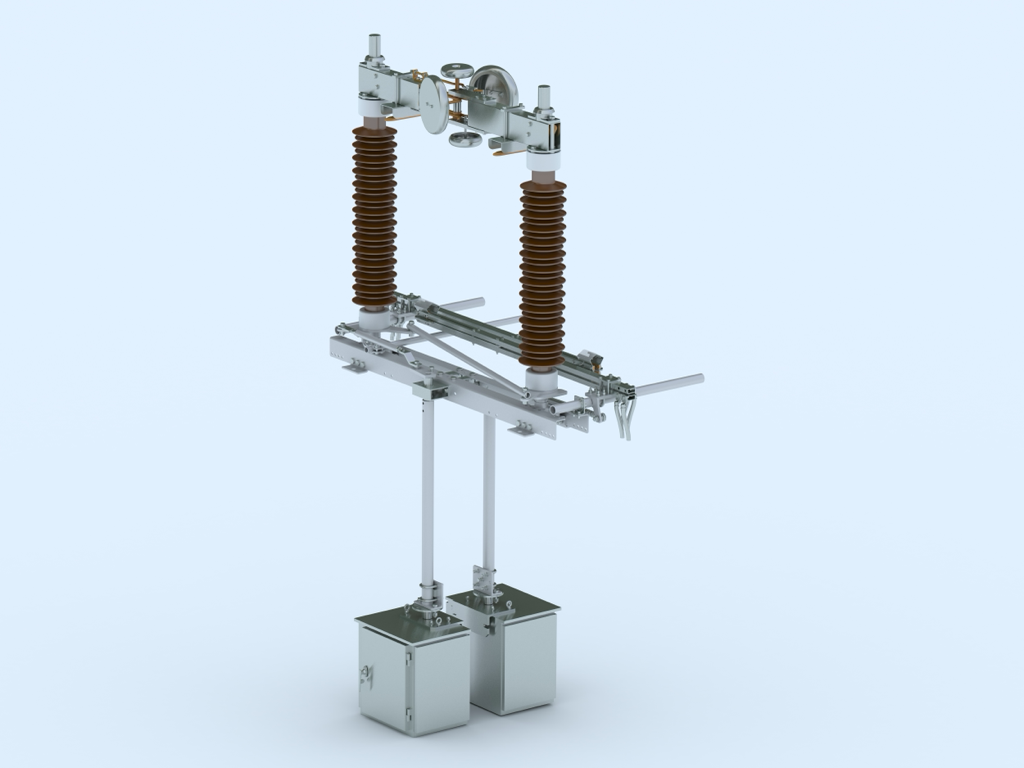
This category covers high-voltage air-insulated disconnectors of the 3DN family: the 3DN1 centre-break and 3DN2 double-side break types (40.5–550 kV, up to 5,000 A, 63 kA short-time withstand) and the 3DN5 knee-type disconnector for substations with limited phase distances. All are type-tested to IEC 62271-102 and can be configured with 3DN0 built-on earthing switches and 3DV6/7 or 3DV8 operating mechanisms for motor or manual operation.
A disconnector (also called an isolator) is a mechanical switch that establishes a rated isolating gap in a high-voltage circuit — a visible break in open-air designs — so that a section of the network is verifiably separated before anyone works on it. When closed it carries the full load current and withstands short-circuit current, but it cannot interrupt load or fault current — the circuit breaker must always open the circuit first. Disconnectors are usually combined with earthing switches, which connect the isolated section to earth so that trapped charge and induced voltages cannot endanger working staff. Glossary →
System-voltage coverage per family (√ scale) — bars link to the product pages. Families without a published kV rating are not drawn.
4 of 4 products
Why it matters
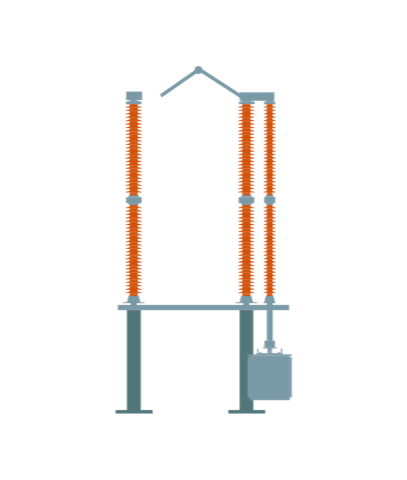
Disconnectors are mechanical switching devices that establish a visible isolating gap in a high-voltage circuit, guaranteeing that personnel can work safely on de-energized sections of the network; earthing switches complete that safety chain by removing any remaining potential from substation parts once switching is done. They are essential equipment in air-insulated substations, and the choice of type — centre break, double-side break or knee-type — is driven largely by the available phase spacing and busbar arrangement: centre break gives the largest phase distance in parallel layouts, double-side break suits substations where vertical opening of the current path is not possible, and the knee-type minimizes both vertical and horizontal space demand. Because disconnectors sit outdoors for decades, maintenance-free contact systems are central to keeping lifecycle cost low: spring-free contact designs drawing on more than 40 years of operating experience allow maintenance intervals of 25 years. Ratings in this class reach up to 5,000 A rated current and 63 kA short-time / 160 kA peak withstand, verified by type tests to IEC 62271-102, with duty covering −55 to +55 °C, ice loads of 10/20 mm, coastal atmospheres and strong seismic activity.
Maintenance-free contact system
Spring-free, silver-graphite-coated self-resilient contact fingers provide dry-lubricated, self-cleansing operation with a 25-year maintenance interval, building on a contact-system concept with more than 40 years of operating experience.
Ratings for transmission-grade duty
Rated voltages from 40.5 kV to 550 kV, rated currents up to 5,000 A and short-circuit withstand up to 63 kA (1 s/3 s) with 160 kA peak, type-tested to IEC 62271-102 and also meeting GOST R and GB/DL requirements.
Proven in severe climates
Operational from −55 to +55 °C with icing class 10/20 mm, in coastal regions and in areas of strong seismic activity, on hot-dip galvanized base frames designed for high mechanical and terminal loads.
Fast erection and commissioning
Poles leave the factory routine-tested and pre-adjusted so they can be erected with standard tools, and the IP 55 motor drives (3DV6/7, 3DV8) ship as completely finished units with hand-crank capability for manual operation.
Frequently asked questions
What does a disconnector do, and how is it different from a circuit breaker?
A disconnector is a mechanical switching device that creates a visible isolating gap between substation parts so that a line section is verifiably separated from the network before people work on it. Unlike a circuit breaker, it is not designed to interrupt load or fault current — switching happens essentially off-load, with the breaker clearing the current first. Optional bus-transfer contacts allow commutating currents of up to 1,600 A during busbar transfer, type-tested per IEC 62271-102 Annex B.
What is the purpose of an earthing switch?
An earthing switch guarantees the complete de-energization of high-voltage components before work begins, so that no residual potential is left on the parts a crew will touch. In this catalog, 3DN0 earthing switches are available as built-on units (lateral or integrated on the disconnector base) or freestanding, and can be specified for induced-current switching per IEC 62271-102 Class A or Class B where electromagnetic or electrostatic coupling with adjacent lines induces currents.
Which disconnector type should I choose for my substation layout?
The centre break (3DN1) is the most common choice worldwide: its sideways-opening current path gives the largest phase distance in parallel, diagonal or in-line arrangements. The double-side break (3DN2) is used where phase spacing is limited or vertical opening of the current path is not possible, and its self-interlocked end position also suits indoor installations. The knee-type (3DN5) reduces space demand in both the vertical and horizontal direction while keeping the disconnection highly visible, and a double-knee variant enables particularly compact substation designs.
Are these disconnectors operated by motor or by hand?
Both. The 3DV6/7 and 3DV8 operating mechanisms are motor drives (600/800 Nm rated torque, operating time under 15 s, IP 55) that can also be operated manually with a hand crank; inserting the crank automatically interrupts the motor and control circuit for safe manual operation. Control voltages cover 60–250 V DC and single- or three-phase AC options at 50/60 Hz — the full ranges are listed in each product's specification tables.
What information should I include when requesting a quote?
State the type designation (3DN1, 3DN2 or 3DN5), rated voltage and normal current, required short-time and peak withstand currents, and site conditions such as ambient temperature range, icing class and seismic requirements. Also specify the drive (3DV6/7 or 3DV8, motor or manual), whether 3DN0 earthing switches should be built on, and any bus-transfer capability. The spec tables and variant tables on each product page follow the catalog technical-data columns, so you can reference the exact voltage row you need.
How do I verify the ratings for a specific voltage level?
Each product entry includes the full insulation-coordination values per voltage step — power-frequency, lightning-impulse and, at the upper voltage levels, switching-impulse withstand voltages, both to earth and across the isolating distance — taken from the published technical-data tables. The source brochures are available as downloads on the product pages, including the SHVC disconnectors and earthing switches brochure with the complete 3DN-series data.
What about maintenance and spare parts over the equipment's life?
The contact systems and drive bearings are maintenance-free, with a stated maintenance interval of 25 years, backed by lifetime technical support and service on short notice for the installed fleet. Spare-part supply for AIS disconnectors is handled through the parts service documented on the product pages — see the AIS disconnector spares download for the scope of available parts.