Noedra suites
The Noedra suites form the digital layer of the catalog: Noedra Flow for overhead-line digitalization, Noedra Node for substation digitalization (including the Assetguard PDM and Assetguard GDM field devices), Noedra Shield for OT/ICS grid security, and Noedra Atlas for energy advisory. Each suite is a modular set of solution lines — from dynamic line rating and transformer condition monitoring to NIST CSF-aligned security operations and grid planning studies — designed to integrate with existing equipment regardless of vendor.
Grid digitalization suites are packages of sensors, software, and expert services that add continuous monitoring, analytics, security, and planning support to existing power-grid assets such as overhead lines, transformers, and switchgear. Instead of periodic manual inspection and fixed rating assumptions, they measure real asset condition and operating conditions continuously, so operators can detect developing faults early, use more of a line's actual capacity, and secure the control systems that run the grid. They are typically vendor-agnostic, layering onto installed equipment from any manufacturer rather than replacing it. Glossary →
4 of 4 products
Why it matters
Grid operators are running aging infrastructure through conditions it was never planned for: load patterns that swing harder, renewable generation claiming a larger share of the mix, and congestion building on key transmission corridors. Traditional practice — periodic manual inspection, static line ratings, and siloed substation systems — yields snapshots where continuous awareness is now required, delaying both fault detection and capacity decisions. Digitalization suites address this by instrumenting lines and substations with sensing and predictive analytics, so operators can detect incipient transformer and switchgear faults before they force outages and rate lines on actual conductor and weather conditions instead of fixed assumptions. The same connectivity that enables this also expands the OT/ICS attack surface, which is why grid cybersecurity — asset visibility, threat detection, and compliance with frameworks such as NERC CIP, IEC 62443, and NIS2 — is part of the same product category rather than an afterthought. Advisory work closes the loop, turning monitoring and planning data into long-term decisions on grid evolution, renewable integration, and regulatory compliance.
More capacity from existing corridors
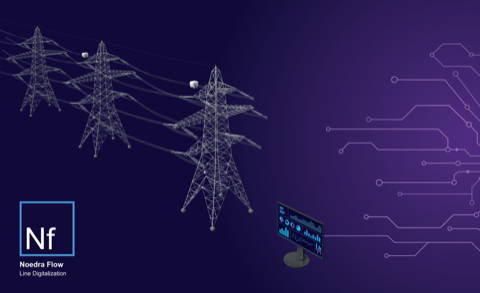
Noedra Flow's dynamic line rating and ambient adjusted ratings (DLR/AAR) compute ampacity from live conductor and weather data rather than static worst-case assumptions, supporting FERC 881 compliance while helping defer line upgrades.
Predictive substation maintenance
Noedra Node monitors transformers (DGA, partial discharge, bushing, OLTC) and AIS/GIS switchgear continuously, detecting incipient faults early to reduce forced outages; its SCADA HMI connects via 300+ protocol drivers with IEC 61850 native support.
OT/ICS security across the full lifecycle
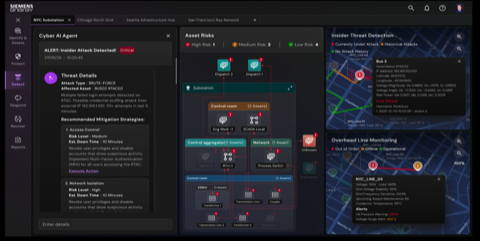
Noedra Shield covers the full NIST CSF lifecycle — identify and assess, protect, detect, respond, recover — for grid OT/ICS environments, with compliance reporting aligned to NERC CIP, IEC 62443, and NIS/NIS2.
Planning grounded in delivery scale
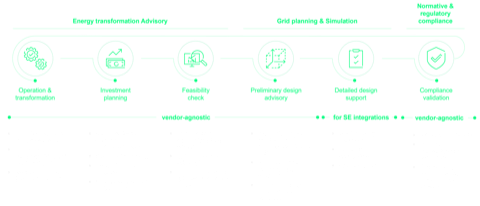
Noedra Atlas draws on 200+ core experts delivering 1,200+ studies and projects per year across 40+ customer countries, providing vendor-agnostic advisory from transformation strategy through grid planning and simulation to compliance.
Frequently asked questions
What is Noedra and how do the four suites relate to each other?
Noedra is the umbrella framework for grid digitalization: a connected set of sensing, control, software, and advisory solutions. Each suite covers one operational perspective — Flow watches transmission lines from above, Node adds intelligence inside the substation, Shield secures OT/ICS environments across the whole grid, and Atlas guides long-term planning and investment. They work independently but belong to one connected ecosystem, so line, substation, security, and planning perspectives contribute to the same operational picture.
What is dynamic line rating (DLR/AAR) and why would I use it instead of static ratings?
Static ratings assume fixed worst-case weather, which leaves real transmission capacity unused most of the time. DLR and ambient adjusted ratings compute line ampacity from live conductor and weather measurements, letting operators safely carry more power on existing corridors, integrate more renewables, and meet regulatory requirements such as FERC 881. Noedra Flow pairs the live sensor measurements with automated rating calculations and feeds the results into existing grid control systems, so the higher ratings are directly usable in operations.
What does IEC 61850 process bus mean for a digital substation?
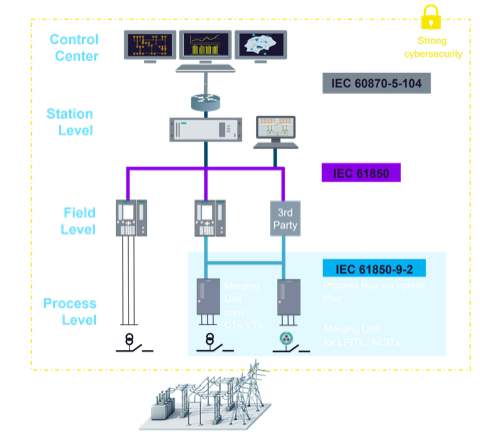
In a process-bus architecture, merging units digitize current and voltage signals close to the primary equipment and stream them over fiber optics, in place of dedicated copper runs back to the control house. That means far less wiring to engineer and test, better signal integrity and time synchronization, and a modular station that is simpler to extend later. Noedra Node is IEC 61850 native (MMS, GOOSE, 9-2 process bus) and its PAC engineering service delivers interoperable station-bus and process-bus architectures on OEM-agnostic hardware.
How do I choose which suite to start with?
Start from the asset class under pressure: congested or weather-exposed transmission corridors point to Flow; aging transformer or switchgear fleets and fragmented substation systems point to Node; audit or compliance exposure on OT/ICS systems points to Shield; and open planning or investment questions point to Atlas. Each product page in this category lists the suite's solution lines in a comparison table (for example, Flow's DLR/AAR vs. situational awareness vs. advanced inspection) so you can match scope before requesting a quote. The suites are modular, so a single solution line is a valid entry point.
What information do I need to request a quote for a Noedra suite?
Describe the asset scope: number and voltage level of substations or line kilometers, the equipment involved (transformer fleet size, AIS or GIS switchgear), and your existing SCADA or control-system protocols. State your preferred deployment model — Noedra Node, for example, can run on-premises, virtualized, or in the cloud. For Node field hardware, reference the catalog designations Assetguard PDM Field Device or Assetguard GDM; the spec tables (Suite, Capabilities, Integration, Deployment) and brochure downloads on each product page cover the remaining technical detail.
Do the Noedra suites work with equipment from other manufacturers?
Yes. The suites are explicitly vendor-agnostic: Node's PAC engineering supplies OEM-agnostic hardware and integrates third-party systems, its SCADA HMI supports 300+ protocols, and Shield inventories and monitors OT/ICS assets regardless of vendor. This means digitalization can be layered onto an existing mixed-generation installed base without replacing equipment.
How do the suites fit into the lifecycle of my installed equipment?
Monitoring data from Flow and Node feeds directly into maintenance planning — condition indicators such as DGA trends, breaker prognostics, and gas density flag which assets need intervention and when, shifting work from time-based to condition-based schedules. Registering your installed base against the catalog links each asset to its documentation, field-device manuals, and service options. Brochures and operating manuals for the suites and their field devices are downloadable from the product pages, and lifecycle service can be scoped through the same quote-request flow.