Distribution transformers
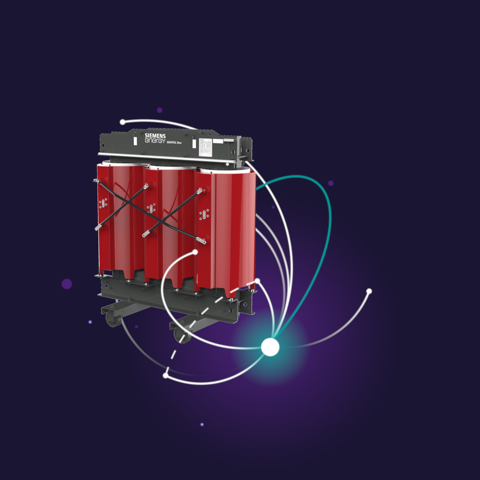
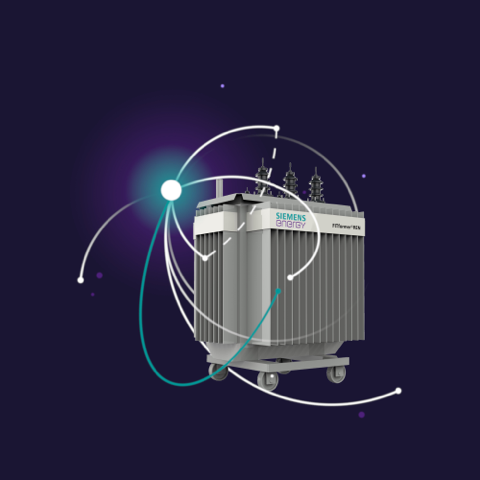
This category covers the two distribution transformer technologies in our catalog: the fluid-immersed FITformer® family (DT-O, 50 kVA–5 MVA at up to 36 kV, with REN variants for renewables up to 20 MVA / 145 kV Um) and the GEAFOL / GEAFOL Neo cast-resin dry-type family (DT-CR, up to 50 MVA / 52 kV per IEC 60076-11). Both are loss-optimized to the EU Ecodesign Directive 2009/125/EC and Regulation (EU) 2019/1783, and both are available with digital monitoring options.
A distribution transformer performs the final voltage conversion in a power network, stepping medium voltage (typically up to 36 kV) down to the low voltage delivered to consumers — or stepping power from local generation such as wind and solar up into the grid. Units are built in two technologies: liquid-immersed, with the windings in an insulating liquid inside a sealed tank, or dry-type, with the windings cast in epoxy resin for indoor and fire-sensitive locations. Ratings run from tens of kVA to a few MVA per IEC 60076 (dry-type units per IEC 60076-11), and because these units are energised around the clock, their no-load and load losses are regulated (EU Ecodesign) and dominate lifetime cost. Glossary →
System-voltage coverage per family (√ scale) — bars link to the product pages. Families without a published kV rating are not drawn.
4 of 4 products
Why it matters
Distribution transformers sit at both ends of the modern grid: they are the last conversion step that delivers usable low-voltage power to consumers, and increasingly the first step that feeds decentrally generated power — wind, PV, battery storage — back into the network. Unlike power transformers, which are sized for continuous full-load transmission duty, distribution units spend most of their life at partial load, so their no-load and load losses dominate lifetime cost and are now regulated directly (EU Ecodesign, US DOE rules). Grid operators also rely on them for voltage quality: regulated variants adjust their ratio under load, so utilities can absorb fluctuating renewable infeed without drifting outside voltage limits. Finally, the insulation technology choice — sealed fluid-filled tank versus cast-resin dry-type — determines where a unit can be installed, from outdoor compact stations to fire-sensitive indoor rooms, data centers, and even wind-turbine nacelles. Getting the technology, rating, and loss class right at specification time avoids decades of avoidable losses and siting constraints.
Regulated low-loss designs
Both families are loss-optimized to the EU Ecodesign Directive 2009/125/EC and Regulation (EU) 2019/1783 — the GEAFOL Neo ordering series meets Tier 2, with per-unit no-load and load losses published in the catalog table.
Two insulation technologies, one category
Fluid-immersed units offer high power density and overload capability in a hermetically sealed, welded tank for outdoor and utility duty; GEAFOL cast-resin units carry E2 / C3 / F1 classification per IEC 60076-11 — flame-resistant, self-extinguishing, and suitable for indoor and fire-sensitive locations without insulating liquid.
Built for renewable feed-in
FITformer® REN variants cover wind, PV, and battery storage up to 20 MVA / 145 kV Um, including ester-filled nacelle-mounted offshore designs to IEC 60076-14; at solar sites, the touch-proof design lets units be installed indoors or outdoors with no additional enclosure.
Minimal maintenance, optional monitoring
Sealed-tank fluid units and cast-resin units are largely maintenance-free by design; both can be ordered with Sensformer® digital monitoring, and fluid units additionally with SITRAM® H2Guard Lite online hydrogen (DGA) monitoring.
Fluid-immersed distribution transformers — official portfolio structure
Fluid-immersed (FIT) distribution transformers are planned by application slice and insulating fluid in the official hierarchy. Ester-filled variants of each slice are their own ordering families.
| Portfolio slice (official hierarchy) | Insulating system |
|---|---|
| FIT Converter < 2,5 MVA | Mineral oil |
| FIT Converter < 2,5 MVA | Ester-filled |
| FIT Converter >= 2,5 MVA | Mineral oil |
| FIT Converter >= 2,5 MVA | Ester-filled |
| FIT Large > 3,15 MVA | Mineral oil |
| FIT Large > 3,15 MVA | Ester-filled |
| FIT OLTC | Mineral oil |
| FIT OLTC | Ester-filled |
| FIT Others incl. Special Transformers | Mineral oil |
| FIT Others incl. Special Types | Ester-filled |
| FIT Overhead Type | Mineral oil |
| FIT Overhead Type | Ester-filled |
| FIT Pad Mounted | Mineral oil |
| FIT Pad Mounted | Ester-filled |
| FIT Solar < 2,5 MVA | Mineral oil |
| FIT Solar >= 2,5 MVA | Mineral oil |
| FIT Stand. incl. Subst.<=3,15 MVA | Ester-filled |
| FIT Standard incl. Subst. <=3,15 MVA | Mineral oil |
| FIT Voltage Regulator | Mineral oil |
| FIT Voltage Regulator | Ester-filled |
| FIT Wind < 2,5 MVA | Mineral oil |
| FIT Wind >= 2,5 MVA | Mineral oil |
| TT EMU | Mineral oil |
| TT LOC | Mineral oil |
24 ordering slices · source: official GT product hierarchy (Rev03) · every slice engineered to order —
Dry-type distribution transformers — official portfolio structure
Dry-type (cast-resin GEAFOL) distribution transformers are planned by application slice in the official hierarchy; see the GEAFOL family pages for the platform technology.
| Portfolio slice (official hierarchy) | Insulating system |
|---|---|
| DRY Converter < 2,5 MVA | Dry-type (cast-resin) |
| DRY Converter >= 2,5 MVA | Dry-type (cast-resin) |
| DRY GEAFOL Lite | Dry-type (cast-resin) |
| DRY Solar < 2,5 MVA | Dry-type (cast-resin) |
| DRY Solar >= 2,5 MVA | Dry-type (cast-resin) |
| DRY Standard > 5 MVA (AN cooling) | Dry-type (cast-resin) |
| DRY Standard incl. Subst. <=3,15 MVA | Dry-type (cast-resin) |
| DRY Wind < 2,5 MVA | Dry-type (cast-resin) |
| DRY Wind >= 2,5 MVA | Dry-type (cast-resin) |
9 ordering slices · source: official GT product hierarchy (Rev03) · every slice engineered to order —
Frequently asked questions
What is the difference between a distribution transformer and a power transformer?
Power transformers serve transmission and generation networks at voltages up to the 800 kV insulation class and ratings from roughly 30 MVA to over 1,300 MVA and are designed for continuous full-load transmission duty. Distribution transformers operate at medium voltage — usually up to 36 kV on the primary side — and step power down for delivery to end users, or step decentralized generation up into the local grid. Because they run mostly at partial load, they are optimized for high efficiency in exactly that regime.
When should I choose a dry-type cast-resin transformer instead of a fluid-immersed one?
A cast-resin unit like the GEAFOL uses vacuum-cast solid insulation and air cooling — no insulating liquid — which makes it the standard choice for indoor and fire-sensitive locations such as buildings, data centers, and enclosed substations; its F1 fire class means it is flame-resistant and self-extinguishing. A fluid-immersed unit keeps its active part in a sealed, welded tank where the insulating liquid doubles as the coolant, supporting compact high-power-density designs with strong overload and thermal reserves for outdoor and utility duty. Compare the keySpecs and the Mechanical & environment spec groups on DT-O and DT-CR to match your installation constraints.
Which insulating liquids are available, and why would I choose ester instead of mineral oil?
Fluid-immersed units can be filled with conventional mineral oil or with synthetic or natural ester liquids. The ester option is readily biodegradable (OECD 301), carries a K-class rating per IEC 61039 with a fire point above 300 °C, tolerates more moisture, and improves tank-rupture prevention by up to 20 % — which is why it is favored in environmentally sensitive locations and in the ester-filled 66 kV nacelle-mounted wind variant.
How do I select the right unit from this category?
Start from the rating and voltage: the DT-O fluid-immersed family covers 50 kVA–5 MVA at up to 36 kV (REN variants up to 20 MVA / 145 kV Um for renewables), while the DT-CR cast-resin family runs up to 50 MVA / 52 kV, with the GEAFOL Neo series up to 6.3 MVA / 40.5 kV. Then check the variant tables on each product page — DT-CR lists per-rating losses, impedance, sound level, weight, and order number for the 100–3150 kVA Tier 2 series — and the environment rows (climate, fire, and protection classes) against your site conditions.
What information do I need to request a quote?
The essentials are rated power (kVA/MVA), primary and secondary voltages, frequency (50 or 60 Hz), impedance requirement, cooling mode (ONAN or KNAN for fluid-immersed, AN or AN/AF for dry-type), the installation environment (indoor/outdoor, IP class, climate class, altitude above 1000 m), and any regulation or monitoring options such as on-load tap changing or Sensformer®. If a listed type designation already fits — for example a GEAFOL Neo order number like 4GX6064-3EY from the DT-CR ordering table — quoting it directly makes the request unambiguous.
Are type designations and ordering data published in the catalog?
Yes. DT-CR lists GEAFOL Neo order numbers (4GB…/4GX… series) together with losses, sound power level, and weight per rating, plus the reconnectable HV tapping range of ±2 × 2.5 %; DT-O lists representative designations for the fluid-immersed family. The downloads on each page — the GEAFOL Neo catalog, the GEAFOL operating instructions, and the 66 kV FITformer® WIND flyer — carry the full ordering data and dimension drawings.
What about spare parts and lifecycle support after installation?
Both families are designed to be largely maintenance-free, and the catalog lists orderable accessories and spares by material number — PT100 sensors, PTC thermistor trigger devices, fan control units, and COMPACT-series spare parts on DT-CR, plus monitoring retrofits like SITRAM® H2Guard Lite on DT-O. Beyond parts, our transformer services cover preventive maintenance, diagnostics such as oil analysis, and repair across the asset's operating life.